
Overview of Fluent Order Management
Essential knowledge
Changed on:
29 Nov 2024
Overview
Fluent Order Management consists of the following key components:- Web Apps
- Modules
- Order Management Experience (OMX)
- Orchestration Engine
- Scalable Cloud Architecture
Key points
- Fluent is made up of modules - Availability, Order, Inventory, Service and Store
- Fluent OMX offers allows low code methods to built out both the UI and Workflows
- Fluent has rich, flexible and comprehensive methods of integration including GQL and Rest APIs
Key Concepts

Fluent OMS
Fluent OMS is soon to replace 'Admin Console'. Note: The learning content may contain some references to both Fluent OMS and Admin Console - they both serve the same purpose. Fluent OMS is the primary user interface for Fluent Order Management. It provides access to manage all areas of the Fluent Order Management Modules:- Availability Module
- Order Orchestration Module
- Inventory Module
- Service Module
- Store Module *You will learn more about the Fluent Order Management Modules later in the course.
Fluent Store
Fluent Store is the in-store web app providing store staff with end-to-end order management capabilities, such as:- pick-and-pack
- ship-from-store
- ship-to-store
Custom Web Apps
Custom Web Apps can be built using the Fluent OMX Platform *You will learn more about the Fluent OMX Platform later in the course.Web apps can be built by configuration using the pre-built component library, enabling clients to create their own specific journeys needed to support their customer and business processes.Web apps can also be customised further by developers using Software Development Kits (SDKs).*You will learn more SDKs later in the course.Headless / Third Party Apps
Fluent Order Management can be used in Headless mode, and allows for Third-party applications such as e-commerce websites and in-store applications to be seamlessly integrated via APIs.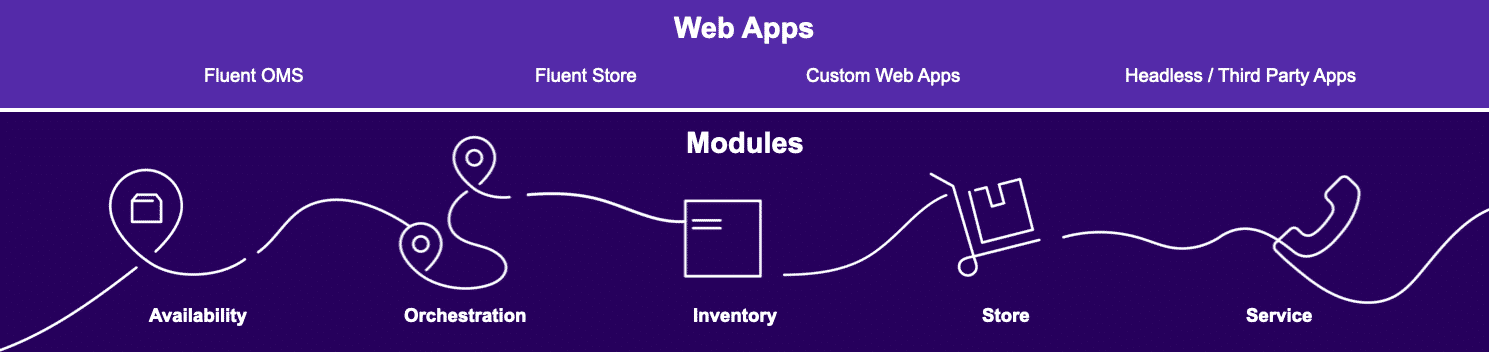
What are Modules?
Modules are areas of capability within a specific Order Management subdomain. Fluent Order Management modules include preconfigured features and functionality using the OMX Frameworks to provide out of the box capability in each area.*You will learn more about Fluent's OMX framework later in this lesson.Fluent Order Management Modules include: Availability, Order Orchestration, Inventory, Service, Store.*You will learn more about this module later in the course.Availability
Availability module provides product availability and fulfilment options to the customer by calculating the inventory available across the networks based on contextual criteria such as no. of product / items in the cart, the customer location, delivery method, and delivery ETAs.The Availability module provides near real time stock checks and fulfilment plans before the buy button on product, cart, and checkout pages, refining the options with each step.*You will learn more about this module later in the course.Order Orchestration
The Order Orchestration module provides clients with the ability to orchestrate orders and sourcing logic across their entire network of locations promoting a true omni-channel customer experience.Note: 'Orchestration' is a broader concept which covers other domains within the Fluent platform, such as Inventory.(opens in a new tab)*You will learn more about this module later in the course.Inventory
The Inventory module provides a global view of inventory across the client organisation. It is intended to be the single 'source of truth' for inventory across all locations and networks.It provides capabilities for managing product data, raw inventory on hand per location, segmentation of inventory across channels, and controls such as buffers and filters to prevent oversells. The Inventory module consists of 4 primary entity domains:- Product Catalogues: for storing product information
- Inventory Catalogues: for storing and tracking raw inventory levels on hand at each location
- Virtual Catalogues: providing segmentation and calculated available to sell / promise (ATS / ATP) for different channels
- Control Groups: for managing buffers and filters applied to inventory in virtual catalogues.
Store
The Store module provides store fulfilment capabilities and processes, such as pick & pack, customer and carrier collections, in-store article arrivals, and in-store returns. Store staff can fulfil orders for click & collect home delivery, and store to store transfers.*You will learn more about this module later in the course.Service
Service has all the capabilities to enable flexible customer support, engage customers from one end of the buying journey to the other, and deepen customer relationships. Specific capabilities include:- Create, edit and cancel orders.
- Add, replace and remove items in an order.
- Update quantity of items on an order.
- Update or change delivery address, delivery method or pickup location.
- Offer appeasements to customers in the form of a credit/discounts.
- Manage returns, exchanges and process refunds.
- Send customer detailed order updates.
- Notify the customer beforehand if the order has been short-picked/back-ordered.
- Process credit memos in the case of a difference in price created when adding or removing an order item
- Search, view and edit customer billing accounts.
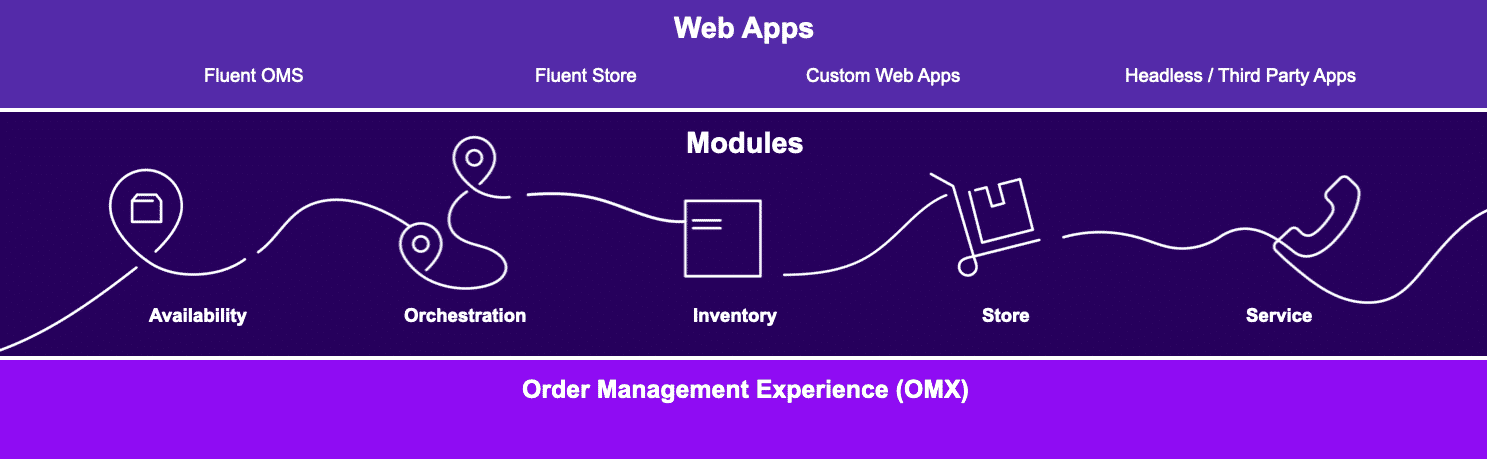
Order Management Experience (OMX)
Fluent's Order Management Experience (OMX) is the low-code platform for order management. The OMX platform is referred to as 'low-code' because it can deliver powerful flexibility through code-free configuration using Configure. Through Extend the platform also provides extendability through Software Development Kits (SDKs) when the standard configuration is not quite enough for clients with unique requirements.OMX provides flexible frameworks for configuring and building custom business logic and user interfaces, delivering agility and speed to market for our clients.Let's break down Configure and Extend
Configure without code
- Front of card Configure without code Click to flip Back of card OMX Configure provides low-code tools to set up user interfaces (UIs) and common workflows using pre-made components. Clients are able to configure the UI through the UI Builder and workflows through the Workflow Builder. Core components of OMX Configure include:
- UI Builder
- Workflow Builder
- Connector Builder *You will learn more about the core components in later modules.
Extend with Software Development Kits (SDKs)
OMX Extend provides extendability through Software Development Kits (SDKs) complete with tools and design patterns that allow clients to build specific integrations and processes.Core components of OMX Extend include:- Component SDK
- Rules SDK
- Connector SDK
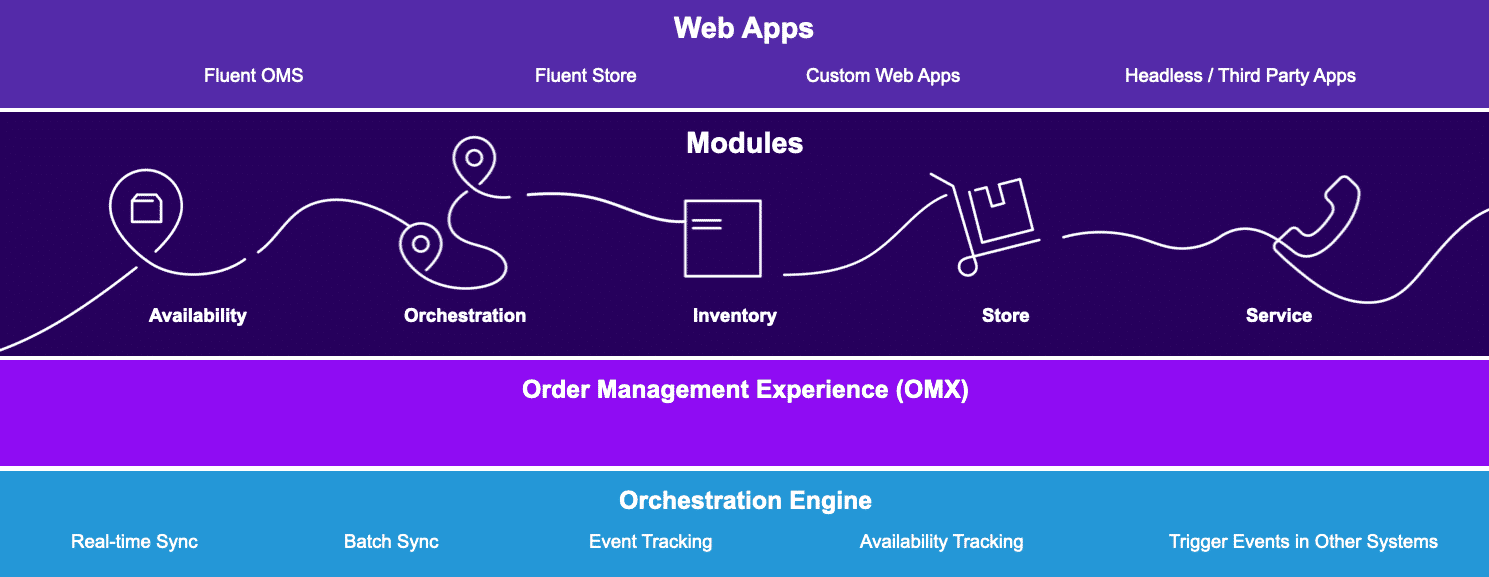
Orchestration Engine
The Orchestration Engine powers the execution of workflows, business logic, and business processes. It enables real-time sync for orchestrated availability calls, high-volume batch processing for inventory loads and updates, event tracking which logs all activities, responds to events triggering execution, and triggers activity in external systems.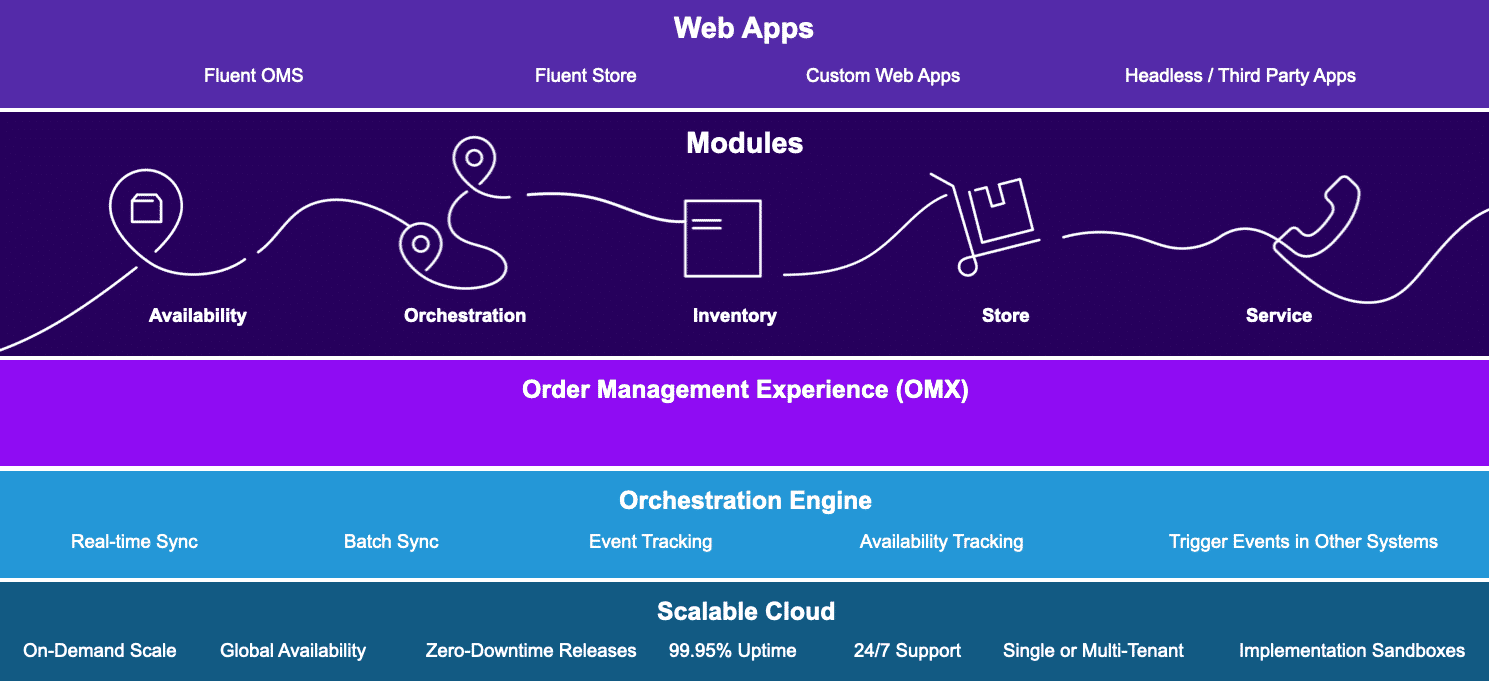
Scalable Cloud
Fluent Order Management is a cloud-native platform, designed to avail most of the benefits of being a cloud-based platform.The scalable cloud provides:- On-demand scale
- Global availability
- Zero-downtime releases
- 99.95% uptime
- 24/7 support
- Shared or Dedicated multi-tenant environments
- Implementation sandboxes
Fluent Order Management's Solutions
Inventory visibility simply means knowing what inventory you have on hand, and where that inventory is located at any given moment.- Track stock in near real-time: Keep inventory data in-sync across all your systems (ERP, POS, WMS, etc.) and partners so you can reduce online out of stocks and increase sales.
- View stock availability across all locations: Know what’s in stock, being processed, and ready for pickup or shipment across all your stores and distribution centers.
- Provide accurate delivery dates: Track expected arrival dates so you can use inbound inventory to fulfil online orders and still provide customers with accurate delivery dates.
- Optimise sourcing and allocation: Ship orders from the best location such as the store with the lowest sell-through, oldest stock, highest discounts, or store closest to the customer.
- Manage buffer stock levels: Set buffer stock (or safety stock) levels by product, category, or location, so you don’t oversell and have to cancel orders.
- Automate order consolidation: Trigger stock transfers if an order needs to be consolidated at a distribution center or store.
- Manage split shipments Set a maximum number of splits based on factors such as order value and customer loyalty status.
- Offer sustainable delivery options: Use existing replenishment routes for stock transfers to reduce your carbon footprint and satisfy consumer demand for ‘green’ delivery'
- Allocate against inbound inventory: Predict future stock availability and if it will arrive on time to meet the customer’s desired delivery date.
Overview of Fluent's Domain Model
Fluent provides a comprehensive and flexible domain model to represent the data and processes critical for running any commerce business. This lesson will explain the available Domain types and how they relate to one another.- Order Management Domain
- Billing Management Domain
- Global Inventory Domain
- Foundation Domain
- Store Fulfilment Domain
- Security Domain
- Shipping Domain
- Payment Domain
- Product Availability Domain
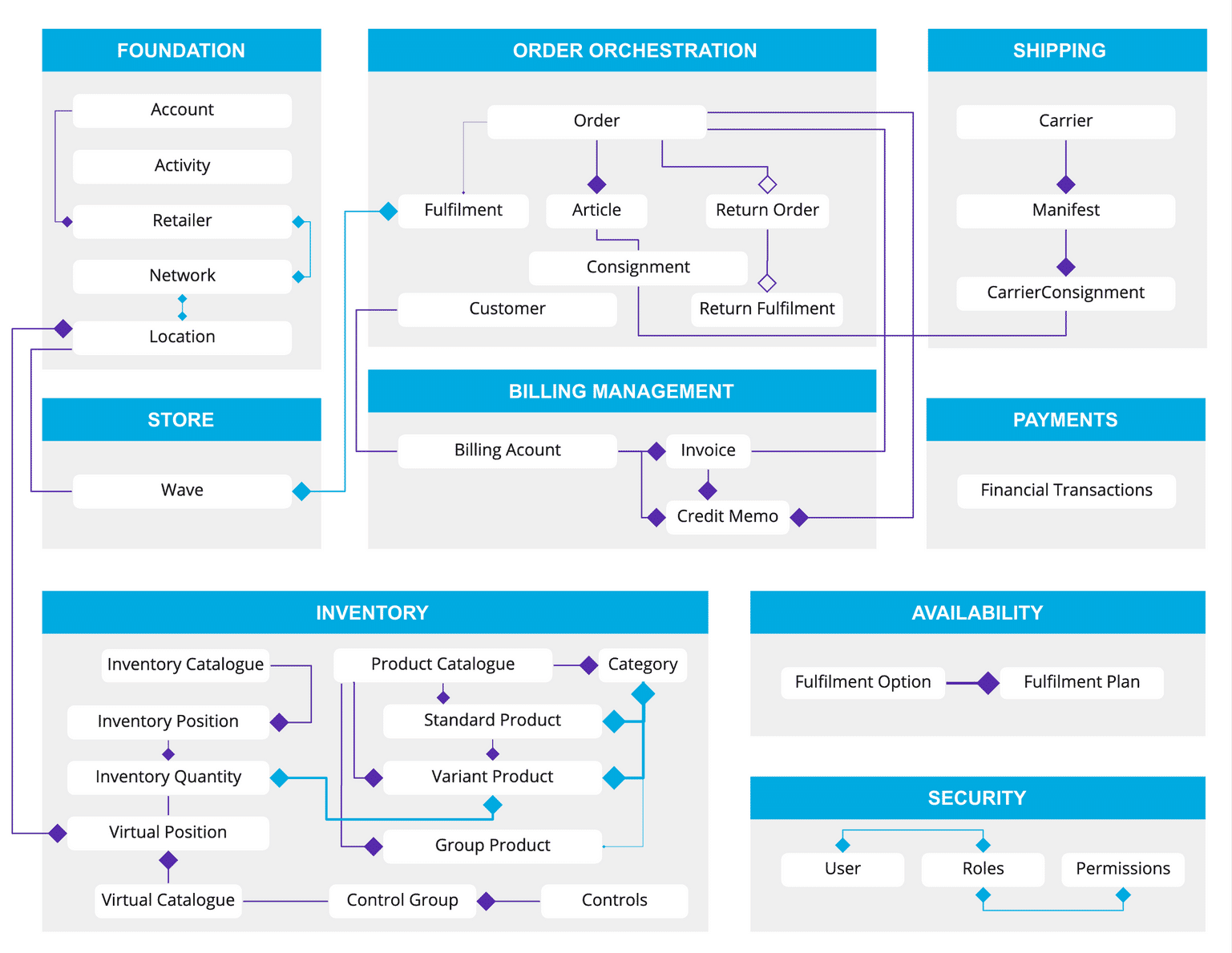
- To enhance and extend the capabilities of the entities described above, visit the GraphQL Schema or GraphQL Explorer.
- To see the complete entity-relationship diagram, read the Domain Model page.
In this topic, you learned about the available domain types within the platform.Next up, Cloud Native Architecture.
Cloud Native Architecture
At Fluent Commerce, we’re committed to providing you with the best technology solutions possible that's why the Fluent platform is built upon industry best-practice cloud technologies.Fluent Order Management is a cloud-native platform designed to avail all of the benefits of being a 100% cloud-based platform.For Users of the Fluent platform, it implies:- Never worry about scale, as the Fluent platform automatically reacts to periods of higher or lower demand and adds or removes resources accordingly.
- Value for money infrastructure sharing and automated scaling ensure efficient use of computing resources.
- Zero-downtime updates for the smallest configuration change to a new version of the software can be applied without impact on retailer operations
- GDPR (General Data Protection Regulation) includes robust requirements that raise and harmonise standards for data protection, security, and compliance.
- Fluent provides 99.95% uptime and 24 x 7 enterprise support.
Cloud Environment
A Cloud environment is a single installation of the Fluent platform. Within each Region, there are several environments set up to cater to different requirements.Types of Environments:- Shared multi-tenant: multiple clients share the same environment which provides efficiency and scale benefits.
- Dedicated multi-tenant: where a client may require a separate cloud which incurs additional costs but is required as per company policies or specific infrastructure requirements.
Regions & Accounts
In the Fluent Order Management System, a Region represents the geographical area in which an Account can be set up. There are several established regions such as Australia, the United States, Europe, and Singapore.Accounts can be set up on either:- Performance Benefit (a region that is closer to the client loads faster).
- Legal Requirements (some jurisdictions have specific rules around data retention)
API, Integration, and Connectors
Fluent Order Management provides you with APIs that let your product or service communicate with our product and services.Application Programming Interface (API), allows two applications to talk to each other.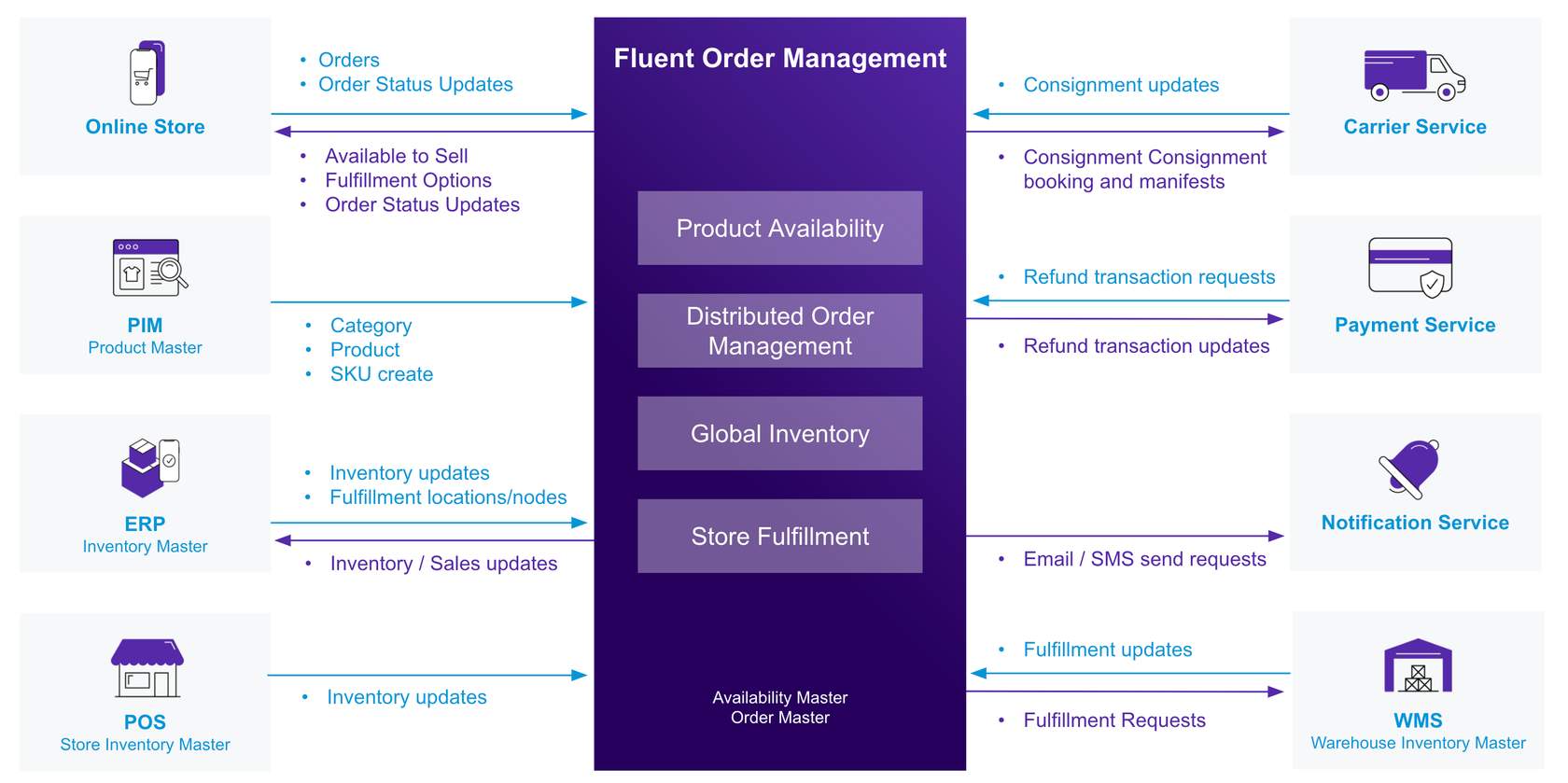
- GraphQL API - Fluent's GraphQL API provides powerful access to data, integration, and orchestration driven business logic.
- ERP - Fluent Order Management can easily connect with CRMs and ERPs.
- Fluent Order Management - Availability, Orchestration , Inventory, Store, Service functionality are designed with flexibility to communicate with other APIs and Connectors
- Carrier Service - Fluent Commerce provides a number of standard webhooks as Rules within the Rule Library for common third party integrations like courier provider hook, or email provider hook.
- Payment Service - Orchestration can talk with Payment APIs and get triggers / events like refund, payment success, fraud checks.
APIs
The Fluent GraphQL API provides powerful access to data, integration, and orchestration-driven business logic. Fluent’s GraphQL API is defined by its data model schema and provides the ability to create, update, query, and search across the core order management domain model.Fluent also provides REST APIs for platform-level integration and access, such as authentication, triggering orchestration events, sending inventory batches, etc.Webhooks
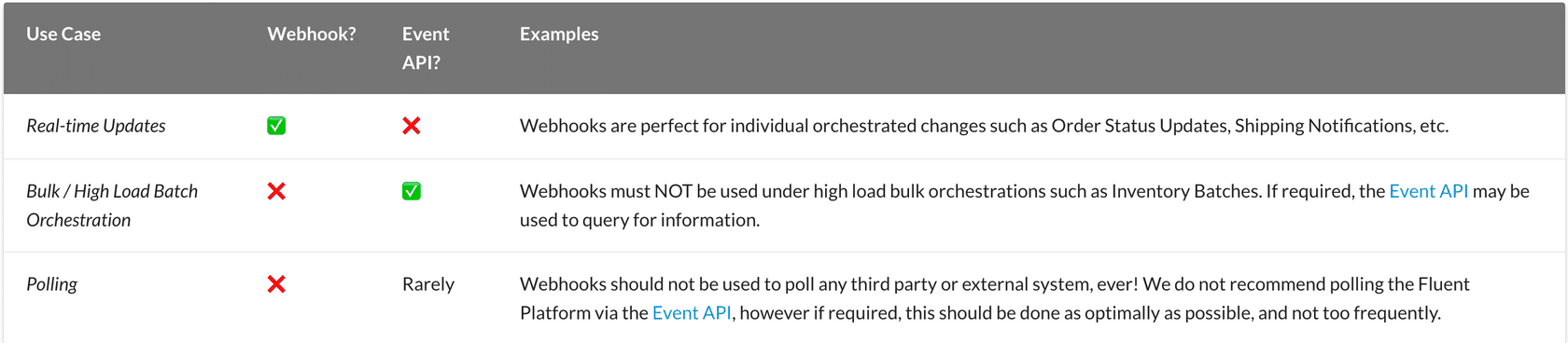
Webhooks enable outbound integration by providing external applications with real-time information. Fluent Order Management provides some standard webhooks as Rules within the Rule Library for common third-party integrations. Following are some examples of webhooks:- Email provider hook
- SMS provider hook
- Carrier aggregator hook
- Courier hook
Connectors
Fluent Order Management includes a growing library of Connectors that provide configuration-based integration with well known 3rd party applications and platforms in the ecosystem. Currently available connectors include:- Salesforce Commerce Cloud (SFCC)
- Salesforce Service Cloud (SFSC)
- Adobe Commerce Cloud
Typical Interface List Example
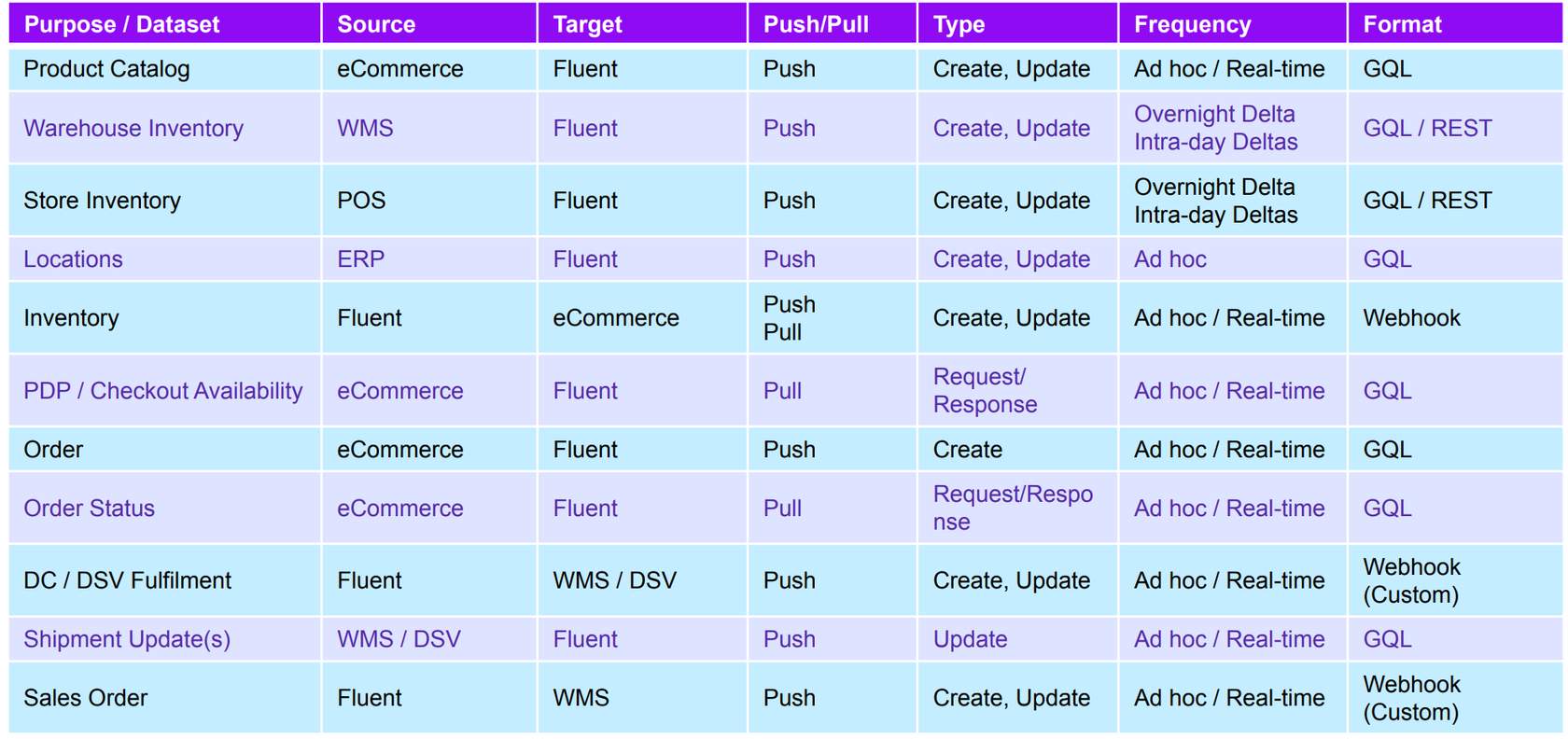
- Purpose/Dataset: This column states some typical datasets / purpose for an API.
- Application Source: This column represents the source application for the respective dataset/purpose.
- Target: This column list the target API for the respective dataset/purpose.
- Push/Pull: Push refers to the Source system pushing data to the Target. Pull refers to the Target system pulling data from the Source system.
- Type & Frequency: These columns show the type and frequency for each integration.
- Format: The items listed in this column represent the types of API (e.g. Create, Update) for their respective purpose/dataset (e.g. Product Catalog).
