
IPC vs. IPU – Understanding Inventory Measuring Models in Fluent Commerce
Essential knowledgeCore knowledge to understand Fluent Commerce
Intended Audience:
Business User
Author:
Holger Lierse
Changed on:
2 June 2025
Overview
Fluent Commerce supports two different models for measuring inventory updates: Inventory Position Updates (IPU) and Inventory Position Changes (IPC). These models play a key role in how we track and charge for inventory processing activity on the platform.With the introduction of Inventory Batch Pre-Processing (BPP) and advancements in ingestion optimization, IPC has emerged as the modern, cost-efficient model. This article outlines the differences between IPU and IPC, how they relate to inventory processing, and when each is applicable.Key points
- Fluent supports two measurement models: IPU (Inventory Position Update) and IPC (Inventory Position Change)
- IPC is the modern model, aligned with actual inventory changes and platform efficiency
- IPU includes all records, even those that don’t result in a change
- IPC model requires BPP to be enabled and is available under Big Inventory contracts only
Inventory Data
What is an Inventory Position (IP)?
An Inventory Position in the Fluent Commerce platform represents the availability of a specific product (SKU) at a specific location. It's the foundational unit used to track and manage inventory across the Fluent Commerce platform.What is a Virtual Position (VP)?
A Virtual Position is a calculated inventory availability for a given product (SKU), often across one or more physical locations, channels, or business rules. It is not tied to a single physical inventory record, but rather represents a logical view of availability.Inventory Updates and Processing
Inventory can be submitted to the Fluent Commerce platform via 2 methods:- Inventory Batch API (bulk ingestion)
- Event API (real-time updates)
- If the record changes inventory, it triggers mutations and contributes to IPC
- If unchanged and filtered by Inventory Batch Pre-Processing, it still contributes to IPU
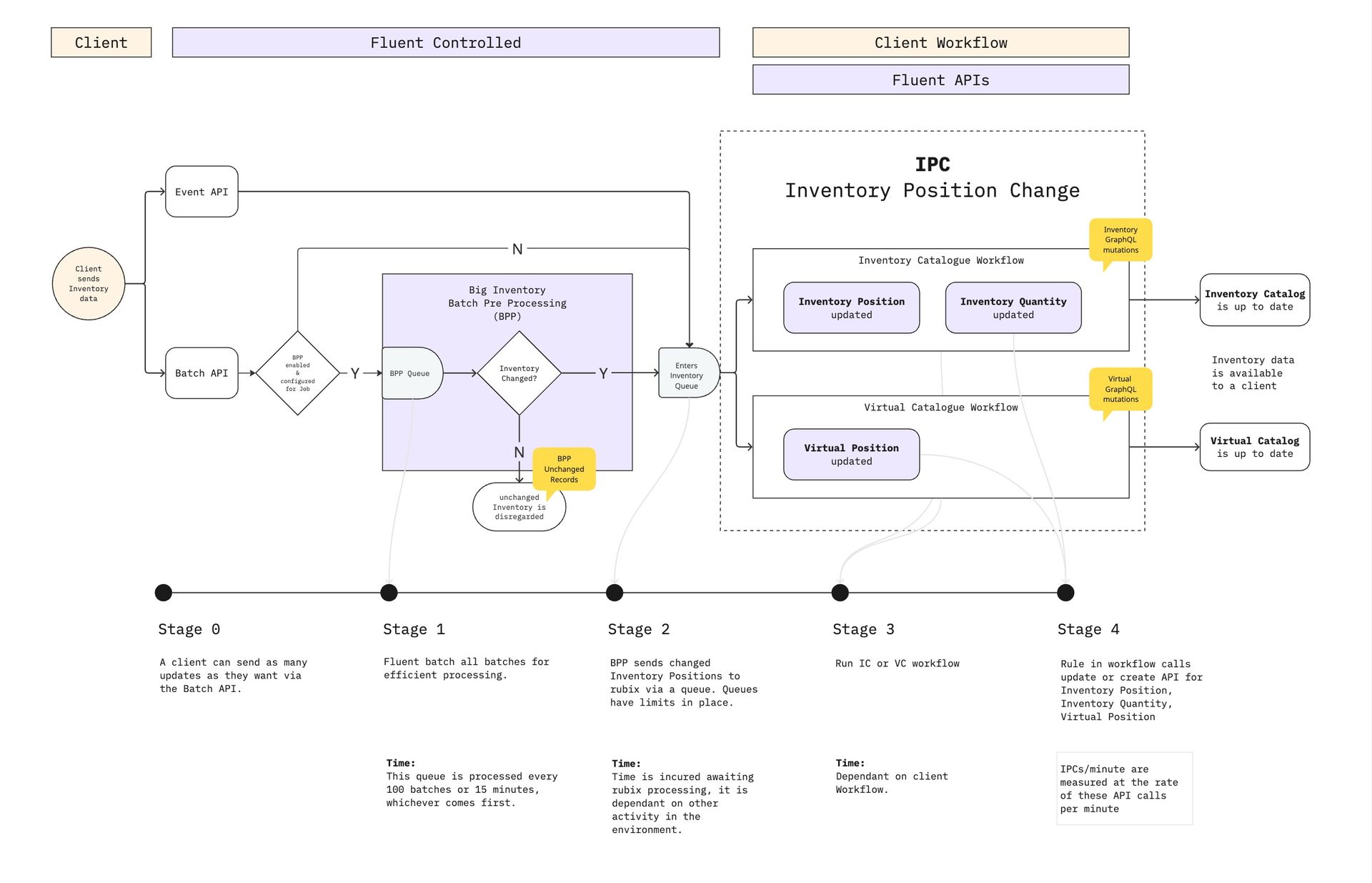
BPP - Inventory Batch Pre-Processing
Inventory Batch Pre-Processing (BPP) plays a critical role in determining how inventory records are evaluated before they reach the workflow engine. Its primary function is to identify whether a submitted inventory record actually differs from what is already stored in the system. If the record is unchanged, BPP filters it out and prevents it from triggering downstream processing and GraphQL mutations resulting in IPCs.This filtering ensures that only meaningful updates — those that change the inventory state — proceed further into the system. As a result, it helps reduce unnecessary processing load and contributes to a more accurate reflection of actual inventory changes across the account. BPP can be enabled or disabled at the account level, but job-level control allows sending systems to decide whether to apply it on a per-batch basis. This gives clients flexibility to optimize ingestion based on their integration capabilities and business needs. By default Inventory Batch Pre-Processing is enabled for all new accounts.IPC – Inventory Position Change
Definition
An Inventory Position Change (IPC) is counted every time a GraphQL mutation is executed that changes inventory data. This includes creation and update operations (see Definition of Product Terms). IPC does not consider any records that have been filtered out during Batch Pre-Processing (BPP).Calculation:`IPC = SUM(GraphQL mutations that result in a change)`Example
In the reference workflow, processing an updated last-on-hand record might result in 3 mutations:`updateInventoryQuantity``updateInventoryPosition``updateVirtualPosition`(depending on the number of Virtual Catalogs)
IPU - Inventory Position Update
Definition
An Inventory Position Update (IPU) refers to any inventory record submitted to Fluent Commerce that either results in a new inventory entry, an update to an existing inventory record, or is ultimately processed without causing a change (see Definition of Product Terms).Calculation:`IPU = IPC + SUM(unchanged records)`Example
Let’s say a client submits a batch of 100 inventory records using the Inventory Batch API.- 60 of those records reflect genuine stock changes (e.g., a warehouse received new stock or sold out of a SKU).
- 40 records are unchanged (i.e., the stock level is the same as what's already in the system).
IPC and IPU Comparison
The table below summarizes how IPC and IPU behave based on whether Batch Pre-Processing (BPP) is enabled or disabled:| Scenario | Record Type | Counts toward IPU Metric | Counts toward IPC Metric | Note |
| BPP Enabled | Changed Record | ✅ | ✅ | Only meaningful inventory updates are processed |
| Unchanged Record | ✅ | ❌ | Eliminates unnecessary processing | |
| BPP Disabled | Changed Record | ✅ | ✅ | Acceptable only if all submitted records are true changes |
| Unchanged Record | ✅ | ✅ | Not recommended - results in redundant processing |
How BPP Affects IPU and IPC Contracts
- If a client is on an IPC contract, BPP is included by default.
→ The client is not charged for unchanged records, since only actual inventory changes (mutations) count toward IPC. - If a client is on an IPU contract,
→ The client is charged for all submitted records — including unchanged records, even if they are filtered out by BPP.
(Because IPU = IPC + unchanged records.)
Why BPP Still Helps in Both Models
- For IPC contracts :
BPP reduces unnecessary mutations, improving performance and ensuring inventory accuracy without inflating IPC counts. - For IPU contracts :
BPP still helps by improving data quality and preventing unchanged records from triggering unnecessary processing. While they’re still charged for unchanged records, IPC counts remain unaffected, which avoids confusion and keeps change-based metrics clean.
