Fluent Commerce Logo
Docs

Stock Segmentation - Data Model and API Overview

Essential knowledge

Author:

Kirill Gaiduk

Changed on:

27 Mar 2026

Overview

Stock Segmentation extends Fluent’s Inventory and Virtual Catalog data models to represent multiple logical segments for the same product and location using explicit, queryable factors.Stock Segmentation supports scenarios such as channel-specific reservations, manufacturing batch traceability, compliance restrictions (for example by country of origin), and supplier-level inventory management while preserving a single physical inventory model per product and location.This document explains the data model and GraphQL API capabilities introduced for Stock Segmentation.

Key points

  • Physical stock in the Inventory Catalog is represented through Inventory Quantities that can be segmented using dedicated fields such as `condition`, `expiresOn`, `countryOfOrigin`, `channel`, `manufacturer`, `manufacturerBatchNumber`, `supplier`, and `segment1/2/3`
  • Inventory Quantities support parent-child hierarchies, allowing multi-level segmentation trees to be modeled explicitly via the parent relationship
  • Inventory Quantities can be linked to operational entities using `associationType` and `associationRef`, particularly for reservation linkage and traceability
  • Virtual availability can expose a single customer-facing segment using Virtual Segments
  • Segmentation fields are exact-match searchable to ensure predictable query behavior (partial matching is not supported)

Data Model

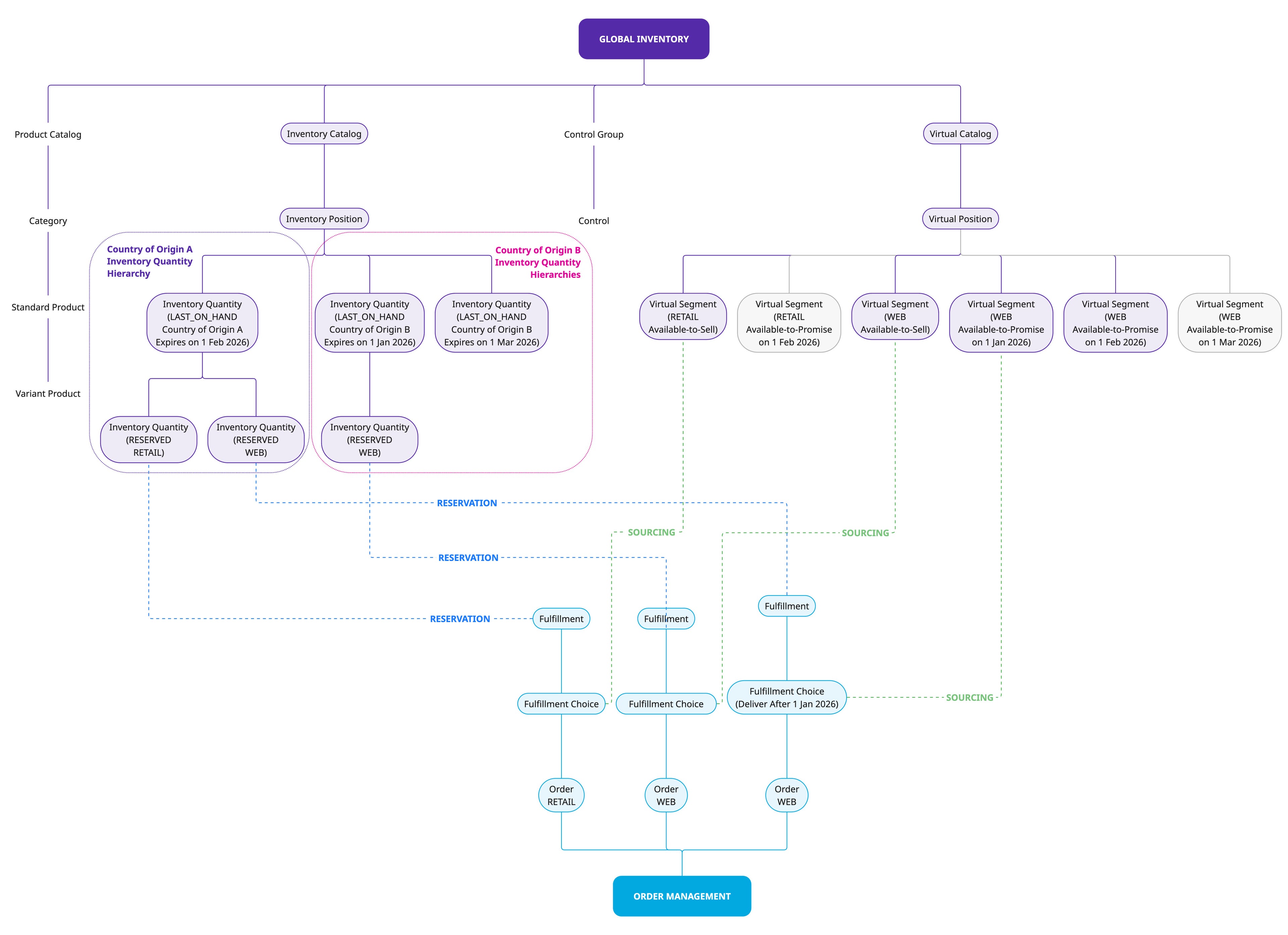
The following mind map shows where the Stock Segmentation solution sits in the Fluent platform.No alt provided
  • Physical inventory is segmented by Country of Origin into Inventory Quantity hierarchies (Country A and Country B)
    • Retail orders are eligible to source only from Country A inventory
    • Web orders may source from both Country A and Country B inventory
  • Allocation follows a first-expiry-first-out (FEFO) principle within the eligible segmentation scope
    • Reservations are created directly against the earliest-expiring eligible `LAST_ON_HAND` Inventory Quantity
    • Grey Virtual Segments indicate that no inventory is Available-to-Promise for that channel at the specified date, based on eligibility and expiry constraints
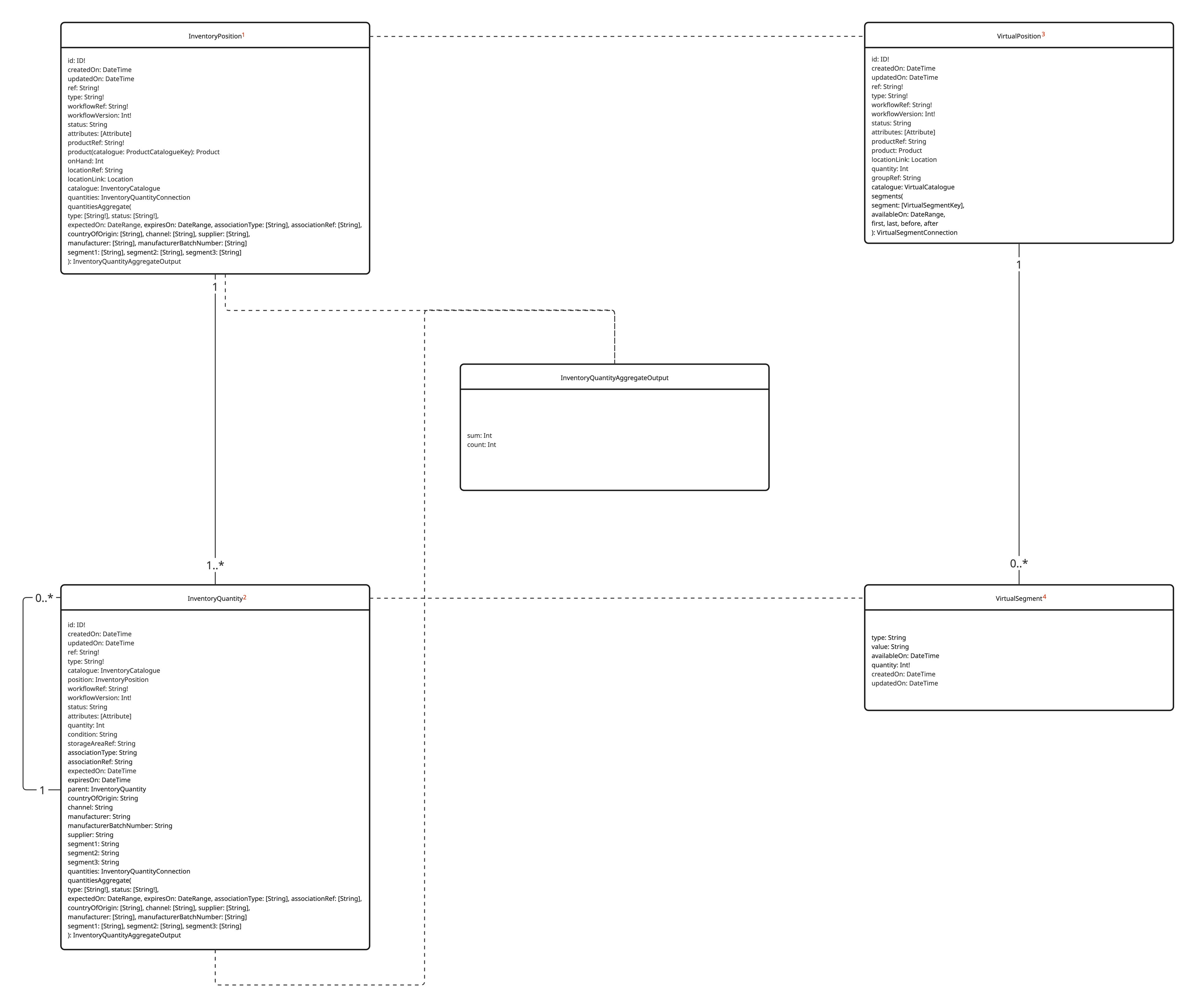
This demonstrates how a single physical stock can be logically segmented while enforcing channel-specific sourcing and regulatory constraints.The following data model outlines the entities available to manage Stock Segmentation.No alt provided

Entities

These are the core entities involved in Stock Segmentation.
EntityDescription
`InventoryPosition`1Inventory Position is the core aggregate entity representing the complete inventory state for a specific product (SKU) at a specific inventory node: a warehouse, store, fulfillment centre, or drop-ship supplier. It is the primary unit of inventory tracking in the platform. A single Inventory Position consolidates all the granular stock information for that product-location combination into one addressable record.
`InventoryQuantity`2Represents a portion of physical inventory within an Inventory Position. In Stock Segmentation, Inventory Quantities may include segmentation attributes (for example `condition`, `supplier`, `countryOfOrigin`, `manufacturer`, `manufacturerBatchNumber`, `expiresOn`, `segment1/2/3`) that logically partition stock without creating multiple physical positions.
`VirtualPosition`3Represents baseline Available-to-Sell inventory for a product at a location. Availability is derived from the underlying segmented Inventory Quantities and reflects the aggregation logic applied across those quantities.
`VirtualSegment`4Represents customer-facing availability scoped to a single segmentation dimension (`type` and `value`). Virtual Segments allow segmented availability to be exposed without duplicating the physical inventory model.

Relationship Details

The following relationship patterns are foundational in the Stock Segmentation model.
RelationshipTypeDescription
Position to QuantitiesOne `InventoryPosition` to many `InventoryQuantity`A single Inventory Position holds all Inventory Quantities for a product at a location, including segmented quantities. This preserves a single physical anchor while allowing multiple logical partitions of the same stock to coexist and be aggregated consistently.
Quantity to QuantitiesOne `InventoryQuantity` to many `InventoryQuantity`Inventory Quantities support explicit parent–child relationships via the `parent` reference. This allows derived lifecycle states (such as reservations or other operational states) to be anchored to a specific segmented quantity, ensuring availability is reduced at the correct segmentation scope.
Quantities to Associated EntityMany `InventoryQuantity` to one associated entityInventory Quantities can be linked to operational records using `associationType` and `associationRef`. In Stock Segmentation, this is primarily used to tie reservations or other lifecycle records to a specific segmented quantity for traceability and accurate availability calculations.
Virtual Position to SegmentsOne `VirtualPosition` to many `VirtualSegment`A single Virtual Position represents baseline availability. Virtual Segments expose availability scoped to a single segmentation dimension (`type` and `value`), enabling channel, market, or customer-facing views without altering the physical inventory structure.

GraphQL Operations

This section summarizes the GraphQL queries and mutations commonly used to work with Stock Segmentation.

Mutations

OperationDescriptionCommon Stock Segmentation InputsReturnsComment
`createInventoryQuantity`Creates an Inventory Quantity record representing a segmented portion of physical inventory or a derived lifecycle record
  • Segmentation attributes:
    • `condition`
    • `supplier`
    • `countryOfOrigin`
    • `manufacturer`
    • `manufacturerBatchNumber`
    • `segment1/2/3`
  • Lifecycle constraints:
    • `expiresOn`
  • Derived quantities:
    • `parent`
  • Reservations / commitments:
    • `channel`
    • `associationType`
    • `associationRef`
`InventoryQuantity`Use to create segmented quantities and derived quantities anchored to a specific segment
`updateInventoryQuantity`Updates an existing Inventory Quantity as inventory progresses through its lifecycle
  • State transitions:
    • `status`
`InventoryQuantity`Use to maintain segmentation data and derived records over time
`updateInventoryQuantityChildren`
  • Bulk updates direct child Inventory Quantities under a specified parent
  • Supports filtering by segmentation attributes and updating status or parent relationships
  • Filter criteria - `UpdateInventoryQuantityChildrenFilterInput`:
    • `parent`
      identifies the parent Inventory Quantity that scopes the operation
    • Child quantities to update selection filters:
      • `type`
      • `status`
      • `expectedOn`
      • `expiresOn`
      • `associationType`
      • `associationRef`
    • Segmentation filters:
      • `countryOfOrigin`
      • `channel`
      • `manufacturer`
      • `manufacturerBatchNumber`
      • `supplier`
      • `segment1`
      • `segment2`
      • `segment3`
  • Updates to apply definition - `UpdateInventoryQuantityChildrenPatchInput`:
    • `status`
    • `parent`
List of updated `InventoryQuantity`
  • Recommended for bulk operations on segmented inventory, such as updating or reassigning a specific subset of quantities based on segmentation attributes
  • Supersedes `updateInventoryQuantitiesStatus` for new implementations
`createVirtualPosition`Creates a Virtual Position and its Virtual Segments used for customer-facing segmented availability
  • Segmented availability:
    • `segments: [UpsertVirtualSegmentInput]`
      Each segment typically includes:
      • `segment: SegmentInput`
        • `type`
        • `value`
      • `quantity`
      • optional `availableOn`
`VirtualPosition` (with segments)Preferred way to create segmented availability projections
`updateVirtualPosition`Updates a Virtual Position and its availability segments
  • Segment updates:
    • `segments` with revised values:
      • `segment`
        • `type`
        • `value`
      • `quantity`
`VirtualPosition` (updated segments)Use to maintain segmented availability projections as they change

Queries

OperationDescriptionCommon Stock Segmentation Filters ReturnsComment
`inventoryPosition.quantitiesAggregate`Aggregates Inventory Quantities under a specific Inventory Position based on lifecycle and segmentation filters
  • Lifecycle state:
    • `type`
    • `status`
  • Segmentation attributes:
    • `condition`
    • `supplier`
    • `countryOfOrigin`
    • `manufacturer`
    • `manufacturerBatchNumber`
    • `segment1/2/3`
  • Time window:
    • `expectedOn`
    • `expiresOn`
  • Reservation context:
    • `channel`
    • `associationType`
    • `associationRef`
Aggregate totals (quantity summary)Primary pattern for position-scoped segment totals
`inventoryQuantity.quantities`Retrieves the direct child quantities for a given parent Inventory Quantity
  • Hierarchy anchor:
    • Parent `InventoryQuantity` reference
List of child `InventoryQuantity`Returns one hierarchy level (direct children only). Useful for tracing derived states
`inventoryQuantity.quantitiesAggregate`Aggregates the direct child quantities for a given parent Inventory Quantity
  • Hierarchy anchor:
    • Parent `InventoryQuantity` reference
  • Lifecycle state:
    • `type`
    • `status`
  • Segmentation attributes:
    • `condition`
    • `supplier`
    • `countryOfOrigin`
    • `manufacturer`
    • `manufacturerBatchNumber`
    • `segment1/2/3`
  • Time window:
    • `expectedOn`
    • `expiresOn`
  • Reservation context:
    • `channel`
    • `associationType`
    • `associationRef`
Aggregate totals (child summary)Use to summarize derived quantities anchored under a specific segmented quantity (for example reservations)
`inventoryQuantities`Searches inventory quantities at a catalog level using filter criteria
  • Lifecycle state:
    • `type`
    • `status`
  • Segmentation attributes:
    • `condition`
    • `supplier`
    • `countryOfOrigin`
    • `manufacturer`
    • `manufacturerBatchNumber`
    • `segment1/2/3`
  • Time window:
    • `expectedOn`
    • `expiresOn`
  • Reservation context:
    • `channel`
    • `associationType`
    • `associationRef`
List of `InventoryQuantity`Useful for reporting or reconciliation patterns not constrained to a single position
`inventoryQuantityAggregate`Aggregates inventory quantities at a position level
  • Hierarchy anchor:
    • `position`
  • Lifecycle state:
    • `type`
    • `status`
  • Segmentation attributes:
    • `condition`
    • `supplier`
    • `countryOfOrigin`
    • `manufacturer`
    • `manufacturerBatchNumber`
    • `segment1/2/3`
  • Time window:
    • `expectedOn`
    • `expiresOn`
  • Reservation context:
    • `channel`
    • `associationType`
    • `associationRef`
Aggregate totalsUse when totals are needed without retrieving records
`virtualPosition`Retrieves virtual availability, including segmented availability evaluation
  • Segmentation:
    • `segment`
      • `type`
      • `value`
  • Optional time evaluation:
    • `availableOn`
`VirtualPosition`  (+ selected segment availability)Returns either baseline Virtual Position quantity or a matching Virtual Segment quantity depending on inputs
`virtualPositions`Retrieves virtual availability across multiple positions
  • Segmentation:
    • `segment`
      • `type`
      • `value`
  • Optional time evaluation:
    • `availableOn`
List of `VirtualPosition`Use in sourcing and promising flows requiring multi-position evaluation
`virtualPosition.segments`Retrieves the Virtual Segment records attached to a specific Virtual Position
  • Segmented availability:
    • `segment`
      • `type`
      • `value`
    • `quantity`
    • `createdOn`
    • `updatedOn`
    • optional `availableOn`
`VirtualSegmentConnection`Use when underlying segment records are needed instead of only the resolved quantity returned by `virtualPosition`

Explanation Through An Example

This example serves as a practical walkthrough of how segmented physical inventory quantities and channel-scoped availability are intended to be represented for a single product and location.

High-Level Example

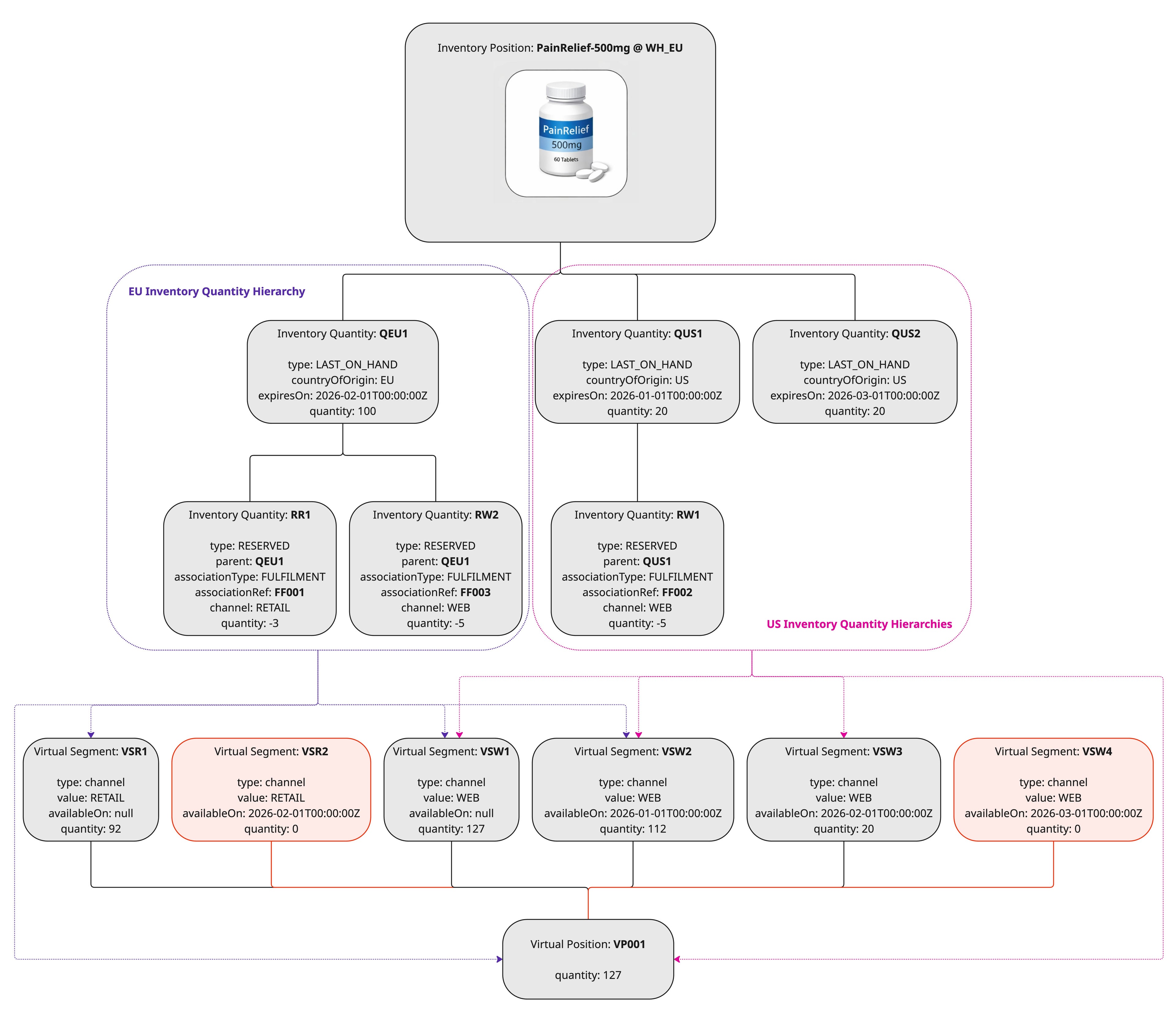
  • Product PainRelief-500mg is managed at location WH_EU
  • Physical stock is segmented by country of origin and expiry date
  • Retail and Web channels have different sourcing eligibility rules
No alt provided

Narrative Overview

  • A single Inventory Position anchors all stock for PainRelief-500mg @ WH_EU.
  • The physical model contains three sibling Inventory Quantities:
    • EU stock: 100 units, expires 2026-02-01
    • US stock: 20 units, expires 2026-01-01
    • US stock: 20 units, expires 2026-03-01
  • Reservations are anchored directly to specific segmented quantities with two important behaviors illustrated:
    • Channel-scoped eligibility
      • Retail reservations can only be created against EU stock
      • Web reservations can be created against EU or US stock
    • Expiry-driven allocation (FEFO)
      • Inventory is consumed from the earliest eligible expiry first
      • However, expiry eligibility is evaluated relative to the order’s delivery window. For example, fulfillment FF003 (deliver after 2026-01-01) cannot reserve against the US batch expiring on 2026-01-01, so it reserves against EU stock instead
  • Virtual Segments then expose this segmented physical model as channel-specific availability projections without duplicating the physical inventory.

Calculation Walkthrough

  • Available now (VP001)
    `LAST_ON_HAND` Inventory Quantities are reduced by reservations already committed against them: VP001 = (100 - 3 - 5) + (20 - 5) + 20 = 127
  • Baseline Retail Availability (VSR1)
    Retail can source EU only: VSR1 = 100 (EU stock) − 3 (Retail reservation) − 5 (Web reservation) = 92
  • Retail available as of 2026-02-01 (VSR2)
    Retail future segment returns 0 because no additional EU inventory becomes eligible: VSR2 = 0
  • Baseline Web Availability (VSW1)
    Web can source EU + US: VSW1 = (100 - 3 - 5) + (20 - 5) + 20 = 127
  • Web available as of:
    • 2026-01-01 (VSW2)
      The US batch expiring on that date is no longer eligible (it is also assumed that the order for which the reservation was made has been fulfilled) --> availability decreases accordingly: VSW2 = (100 - 3 - 5) + 20 = 112
    • 2026-02-01 (VSW3)
      EU batch expires (the orders have been fulfilled) --> only remaining eligible stock is reflected: VSW3 = 20
    • 2026-03-01 (VSW4)
      All batches expired: VSW4 = 0

API Usage

The inventory quantities and availability shown in this example are created and retrieved using the GraphQL mutations and queries described in the GraphQL Operations section. In particular:
  • Segmented physical quantities and reservations are created via `createInventoryQuantity` mutation. Reservations are anchored using:
    • `parent`
    • `associationType`
    • `associationRef`
    • `channel`
  • Channel-scoped availability is retrieved via `virtualPosition` / `virtualPositions` queries. Segmented date-based availability is retrieved using the following parameters:
    • `segment`
      • `type`
      • `value`
    • `availableOn`

Key Insights

  • Reservations are anchored to a specific segmented Inventory Quantity
  • This ensures that availability is reduced only within the eligible segment, preserving deterministic channel-specific availability and expiry-based allocation